The Evolution of the Harley-Davidson V-Twin
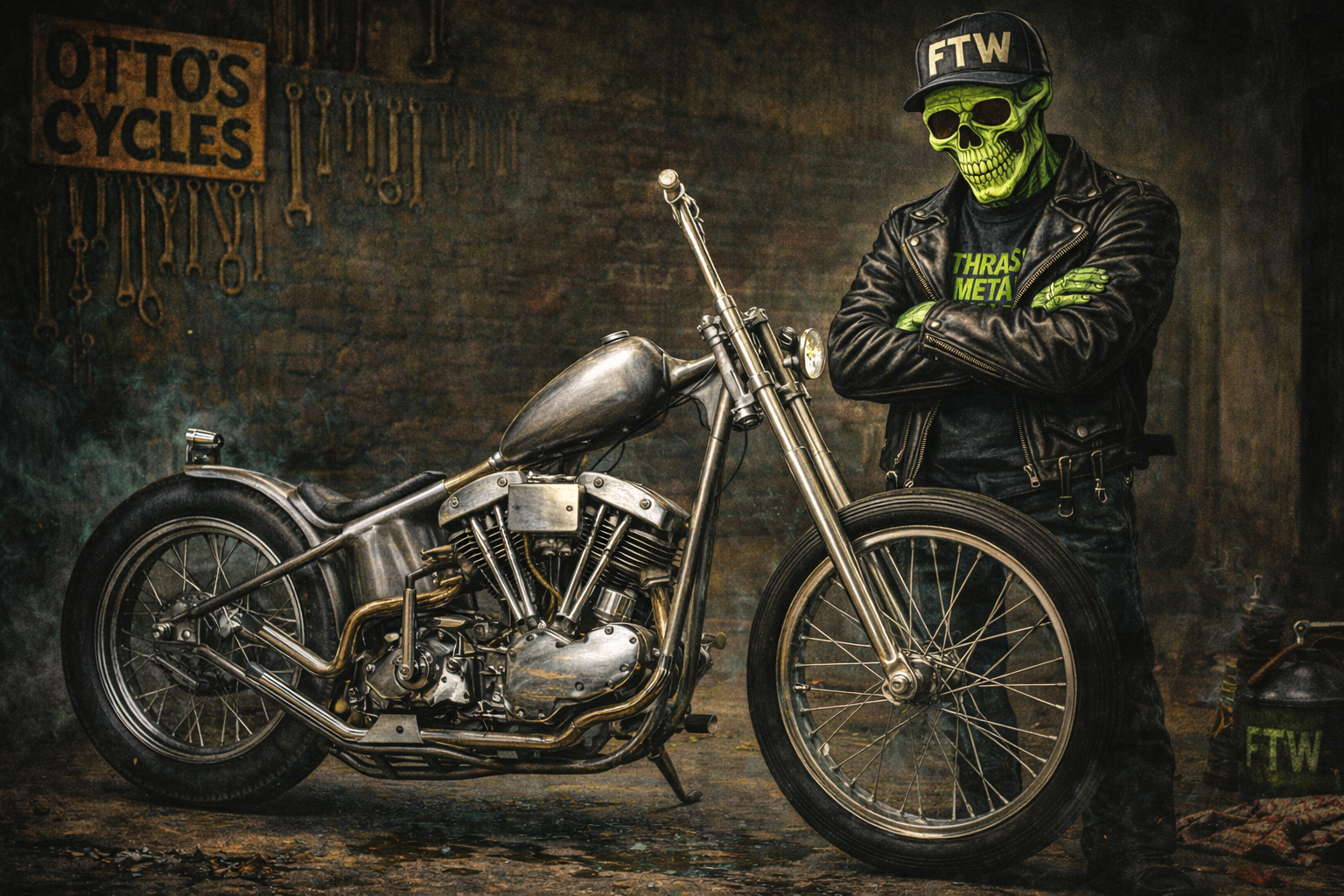
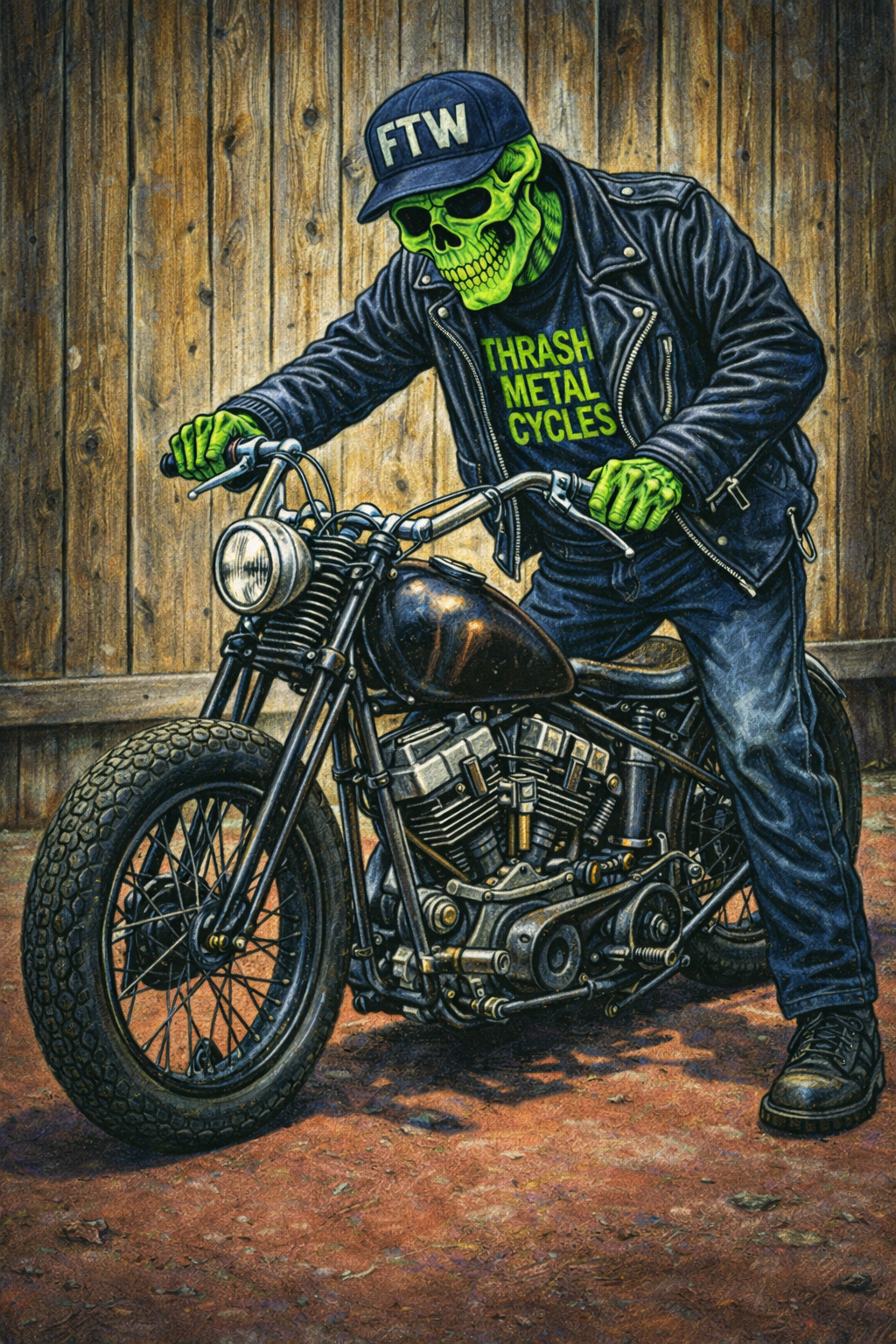
Thrash Metal Cycles
For more than a century Harley-Davidson has returned to the same stubborn mechanical idea: a 45-degree V-Twin with heavy flywheels, a deep exhaust pulse, and torque that arrives like a hammer rather than a calculation.
The details changed. Castings improved. Metallurgy advanced. The personality did not.
From the early F-Head motors to the modern Milwaukee-Eight, Harley’s engine history is less a straight line than a long argument with time. Heat. Emissions laws. Rider expectations. Occasionally the company’s own survival.
Each generation answered a different question.
How do we make it stronger?
How do we make it cooler?
How do we make it last?
And the hardest question of all: how do you modernize a machine without sanding off the thing people love about it?
The answers form a bloodline that runs through more than a century of American motorcycles.
Let’s walk it.
F-Head V-Twin (1911–1929)
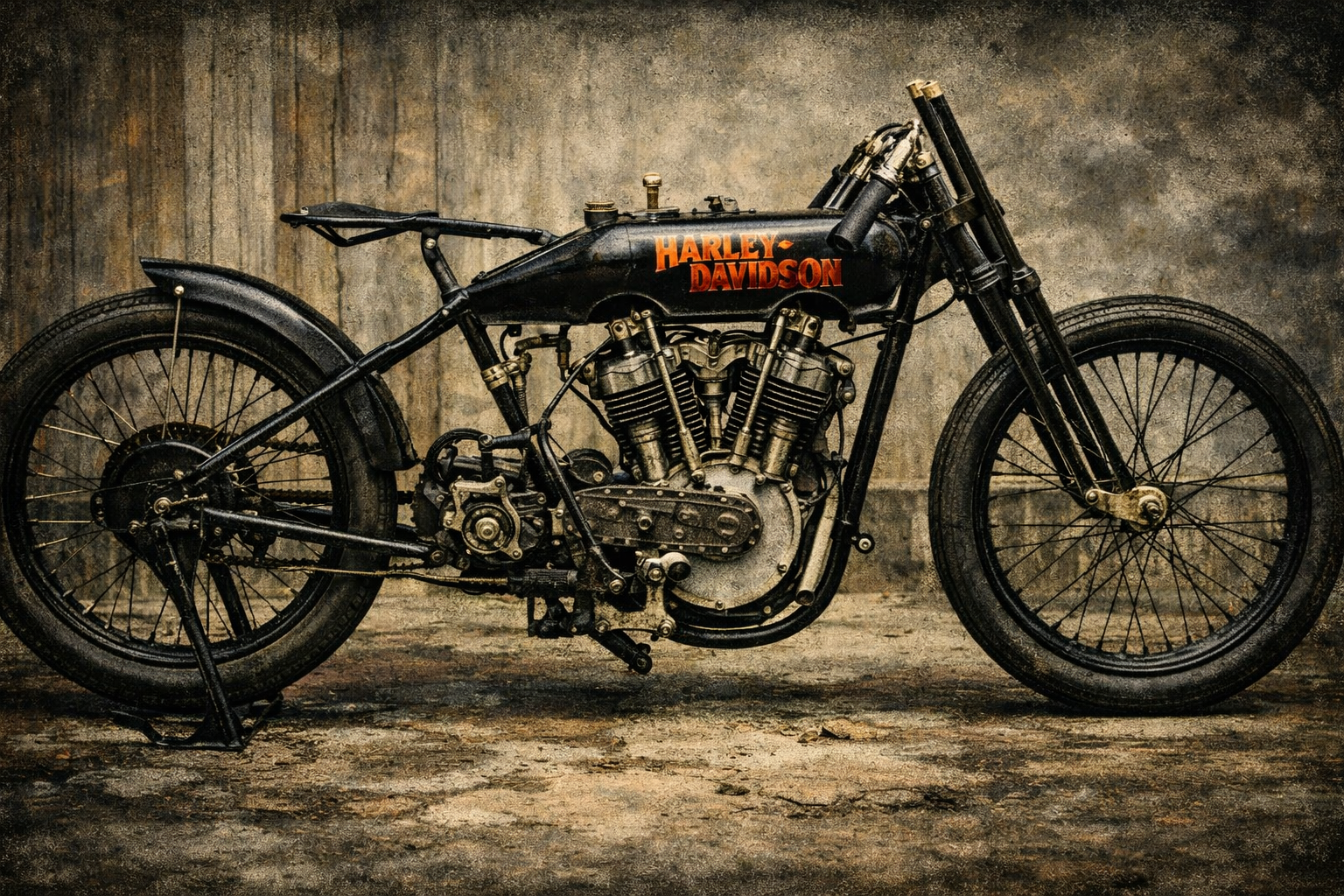
Before the country was stitched together by highways, Harley-Davidson found its footing with the 1911 F-Head V-Twin.
It was the company’s second attempt at the configuration after the short-lived atmospheric engine of 1909. The new motor worked. It used an intake-over-exhaust valve arrangement, began at 61 cubic inches, and eventually grew to 74.
More important than the numbers was the layout. The 45-degree cylinder angle and the broad, usable torque that came with it would become the company’s signature.
By modern standards the machine was primitive. The valve gear looked odd. Ignition systems demanded patience. Riders were expected to bring a certain amount of mechanical sympathy to the relationship.
But primitive did not mean fragile.
These engines carried riders across an America that was still rough around the edges, and in doing so they established the silhouette and mechanical rhythm that still define Harley-Davidson today.
This is where the family resemblance begins.
Before the country was stitched together by highways, Harley-Davidson found its footing with the 1911 F-Head V-Twin.
It was the company’s second attempt at the configuration after the short-lived atmospheric engine of 1909. The new motor worked. It used an intake-over-exhaust valve arrangement, began at 61 cubic inches, and eventually grew to 74.
More important than the numbers was the layout. The 45-degree cylinder angle and the broad, usable torque that came with it would become the company’s signature.
By modern standards the machine was primitive. The valve gear looked odd. Ignition systems demanded patience. Riders were expected to bring a certain amount of mechanical sympathy to the relationship.
But primitive did not mean fragile.
These engines carried riders across an America that was still rough around the edges, and in doing so they established the silhouette and mechanical rhythm that still define Harley-Davidson today.
This is where the family resemblance begins.
Flathead V-Twins (1929–1973)
Then came the Flathead.
Side-valve. Simpler. Tougher. Easier to live with.
Harley introduced the Flathead V-Twin in 1929. It began with the familiar 45 cubic-inch version, but by 1930 the 74-inch V model arrived, followed by the heavyweight U and UL models and eventually the 80-inch UH and ULH engines that defined the big-twin Flathead era.
This is one place where the timeline deserves a little care. If you look at the entire Flathead family, Harley continued building side-valve V-Twins all the way to 1973 through the Servi-Car. If you focus on the big twins that shaped Harley’s street lineage, the story largely lives in the prewar and immediate postwar decades.
Both versions are true. They simply follow different branches of the same tree.
Either way the Flathead earned its reputation honestly. It was not glamorous and it was rarely fast. What it offered instead was durability. Tolerance. A willingness to keep running long after other machines might have given up.
For riders who needed transportation more than theater, that mattered.
Knucklehead (1936–1947)
If there is a moment when Harley-Davidson stops being simply a motorcycle company and starts becoming mythology, it arrives in 1936.
That was the year the Knucklehead appeared.
The engine introduced overhead valves to Harley’s Big Twin while keeping the familiar 45-degree layout. It debuted as a 61 cubic-inch motor and later gained a 74-inch version.
The nickname came from the rocker covers, of course, but the real story was what the motor represented.
Better breathing. More power. A level of engineering sophistication Harley had never offered before.
More important still, the Knucklehead established the basic architecture of the air-cooled Big Twin Harley would follow for decades.
This was not just a new engine. It was the blueprint.
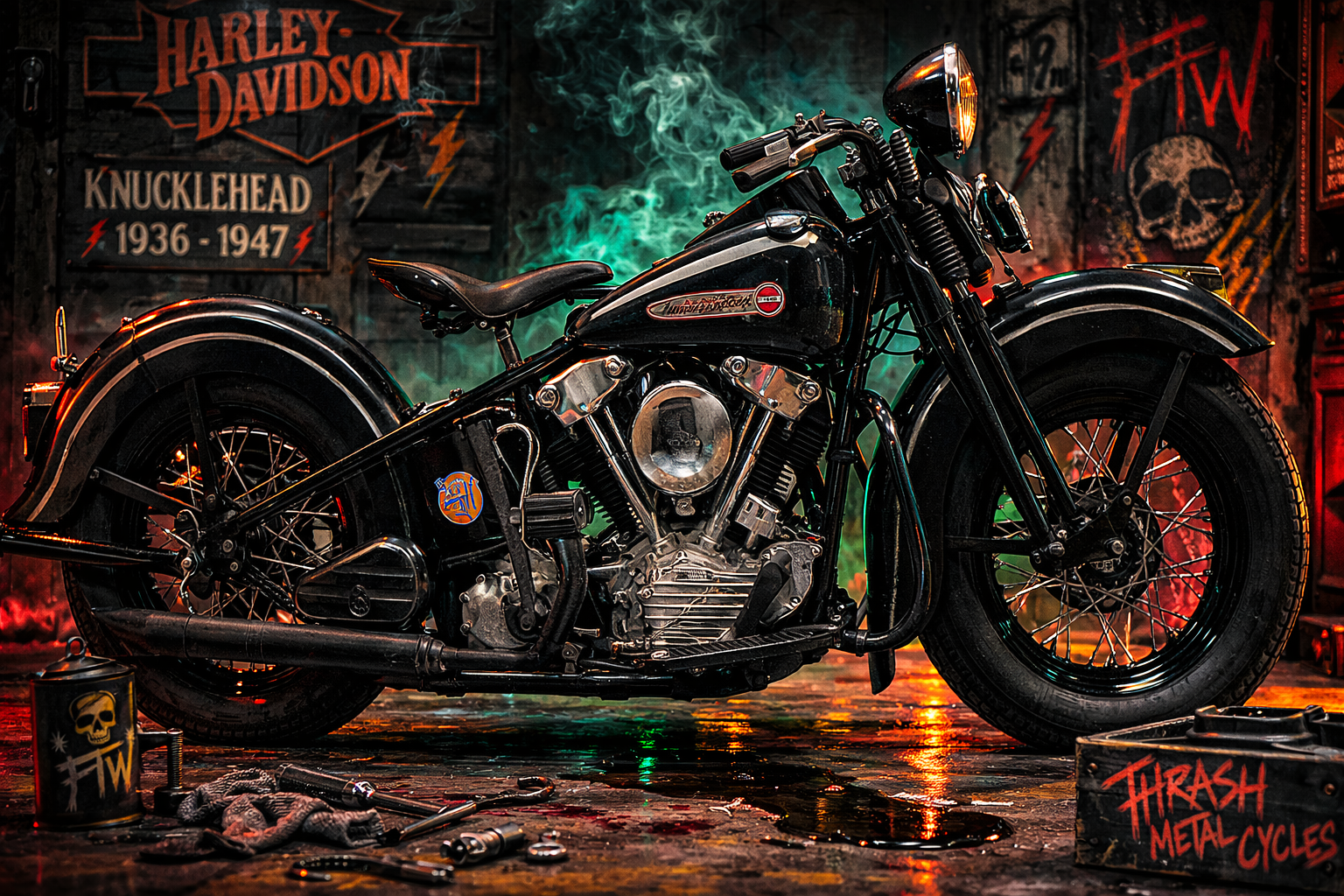
The sound, the torque delivery, the long-legged mechanical rhythm riders still romanticize today all trace their lineage back to this motor.
The Knucklehead did not simply move Harley forward.
It taught the company what its motorcycles were supposed to feel like.
Panhead (1948–1965)
By the late 1940s Harley-Davidson was not looking to reinvent the motorcycle. Riders already knew what they liked. The task was to make it tougher, cooler, and easier to live with.
The result arrived in 1948 as the Panhead.
The basic architecture remained familiar: a 45-degree overhead-valve V-Twin with large flywheels and a broad torque curve. Displacement stayed at 61 and 74 cubic inches. But inside the engine a series of practical improvements began to reshape how the machine behaved in the real world.
Aluminum cylinder heads improved heat dissipation. Hydraulic lifters eliminated the need for constant valve adjustments. The rocker arms were enclosed and pressure lubricated. Oil circulation improved and crankpin bearings were strengthened.
In 1954 Harley redesigned the oil pump, improving the scavenging side of the system so oil returned to the tank more efficiently instead of pooling in the crankcase. For riders it meant a cleaner-running engine and fewer of the wet-sumping complaints that had plagued earlier motors.
It was still unmistakably a Harley Big Twin. It simply asked less of its owner.
The name came from the rocker covers. Their shape resembled upside-down baking pans, and riders quickly began referring to the engine as the Panhead. The nickname stuck, as good motorcycle nicknames tend to do.
The motorcycles built around the engine were evolving as well.
In 1949 the Hydra-Glide introduced telescopic front forks, replacing the long-serving springer design. In 1958 the Duo-Glide added rear suspension. By 1965 the Electra-Glide brought electric start to the big twin lineup and firmly positioned Harley in the long-distance touring world.
While the machines were becoming more comfortable, the Panhead itself was becoming something else entirely: a cultural symbol.
You saw them everywhere. Police bikes. Cross-country touring rigs. Early custom machines and garage choppers.
The Panhead carried the same mechanical DNA that ran through earlier Harleys. The four-cam gear train remained in place. The flywheels were still heavy. The torque delivery was still slow and deliberate.
What changed was the refinement.
The engine could now carry riders across entire states and ask only for fuel and the occasional oil change. For the time, that was progress enough.
Shovelhead (1966–1984)
By the mid-1960s the Panhead had carried Harley-Davidson for nearly twenty years. Riders were asking for more power and better breathing.
In 1966 the answer arrived in the form of the Shovelhead.
The new engine retained the familiar 45-degree overhead-valve layout but introduced redesigned aluminum cylinder heads with larger ports and improved combustion chambers. Stronger valves and pistons allowed the motor to handle higher loads and more heat. The electrical system moved to twelve volts to support the growing demands of modern motorcycles.
Displacement began at 74 cubic inches and later grew to 80 by the late 1970s.
Under the covers much of the earlier Harley DNA remained intact. The same four-cam gear train still drove the valvetrain, and the heavy flywheels continued delivering the long, slow torque curve riders expected.
The nickname came from the rocker covers. Some riders insist they resemble a coal shovel turned upside down. Others see the back of a shovel blade. Either way, the name endured.
Timing mattered.
The Shovelhead arrived just as American motorcycle culture was exploding. The late sixties and seventies saw the rise of custom builders, extended forks, chopped frames, and motorcycles that bore only a passing resemblance to what left the factory.
Harley leaned into that shift in 1971 with the FX Super Glide, the company’s first factory custom. The bike combined a Sportster-style front end with a Big Twin frame and Shovelhead power. It looked different from the touring machines Harley had been known for, and it helped spark a new generation of riders.
The Shovelhead itself was not a perfect engine. Oil leaks were common. Heat management could be difficult. Owners learned quickly that the motor rewarded attention and punished neglect.
But that mechanical personality became part of the legend.
These were the years of roadside repairs, parking-lot tuning sessions, and tool rolls living permanently in saddlebags. Riders learned their machines intimately because sometimes they had no choice.
The reward was unmistakable.
Heavy flywheels building torque down low. A mechanical rhythm pulsing through the frame. The deep exhaust note that could be recognized from blocks away.
The Shovelhead powered everything from stripped-down choppers to police motorcycles and long-distance touring machines.
More than anything, it became the engine of the garage builder.
If the Knucklehead built the Harley legend and the Panhead refined it, the Shovelhead handed the tools to the riders and told them to make something of their own.
They did.
Evolution Big Twin (1984–1999)
By the late 1970s Harley-Davidson was in genuine trouble.
The AMF years had pushed production numbers up but quality down. Oil leaks were common. Electrical failures were common. Riders were beginning to notice that Japanese motorcycles started every morning and rarely left stains on the garage floor.
Harley’s reputation was beginning to fracture.
In 1981 a group of thirteen executives and investors purchased the company back from AMF. That buyout was the first step. It did not fix the motorcycles.
What Harley needed was an engine that proved the company still knew how to build a dependable machine.
That engine arrived in 1984.
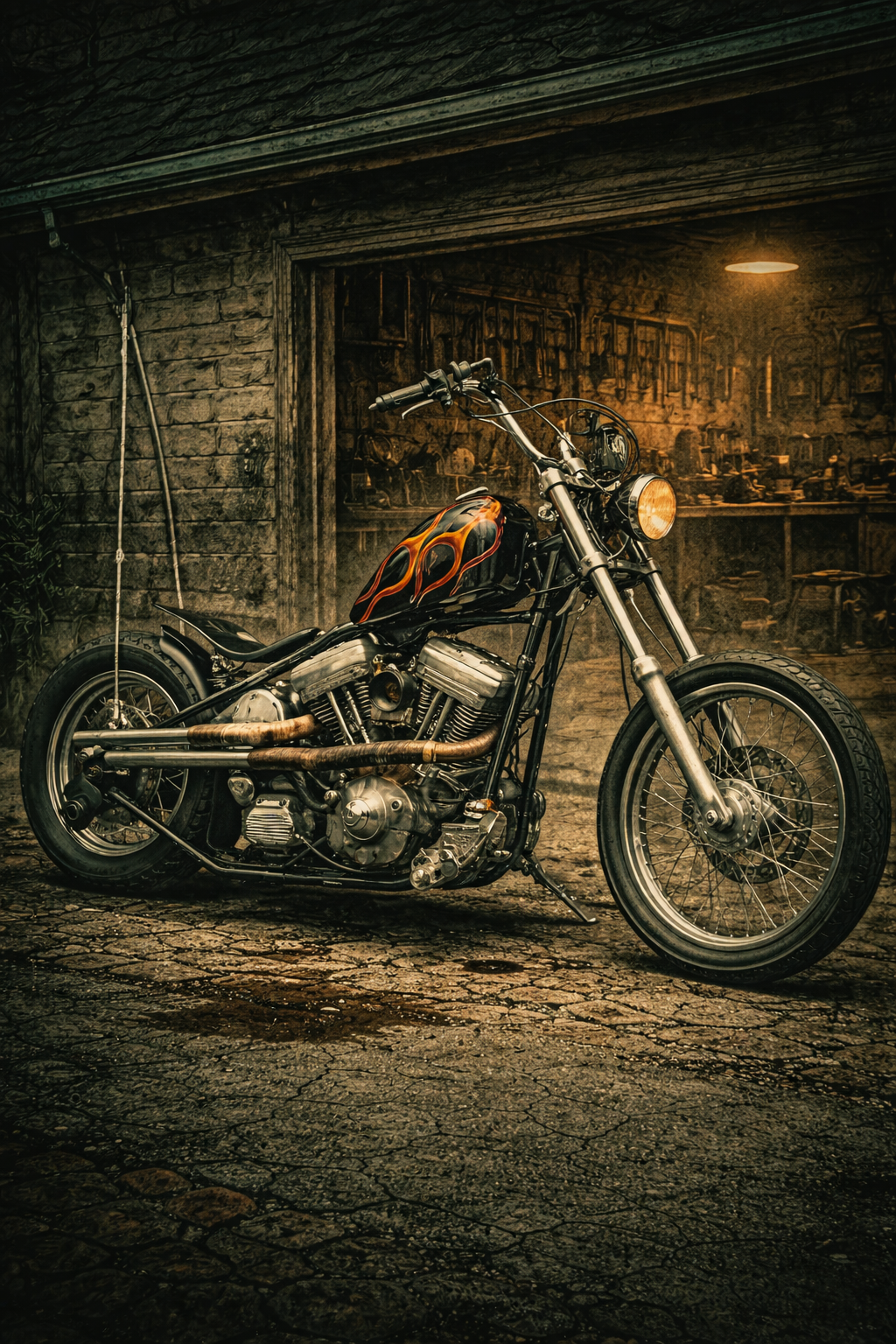
The Evolution Big Twin retained the familiar 45-degree pushrod V-Twin layout but modernized nearly everything else. Aluminum cylinders and heads improved cooling. The oiling system was redesigned. Manufacturing tolerances tightened significantly with the help of computer-aided design.
More important than any single improvement was what the engine solved.
Leaks. Reliability.
The Evolution ran cooler, sealed better, and accumulated miles without constant mechanical attention. Riders discovered they could travel without hauling an entire workshop in their saddlebags.
Dealers suddenly had something simple to say again.
This one works.
The timing could not have been better. Harley had petitioned the U.S. government for temporary tariffs on large imported motorcycles, buying the company time to rebuild. But time alone would not save Harley-Davidson. The motorcycles still had to justify their existence.
The Evolution did exactly that.
Magazines began reporting improved reliability. Owners began reporting real mileage. Custom builders embraced the platform for its strength and simplicity.
Riders returned.
Through the late eighties and nineties the Evolution-powered Softails, FXRs, Dynas, and touring machines. It became the backbone of Harley-Davidson’s recovery and the engine that restored much of the company’s reputation for durability.
It did not chase horsepower headlines.
It simply worked.
Sometimes that is the engine a company needs most.
Without the Evolution, Harley-Davidson might not have reached the modern era at all.
Twin Cam (1999–2017)
By the late 1990s Harley needed another step forward.
The Twin Cam arrived in 1999 at a moment when Harley-Davidson needed to move forward without losing the thing that made its motorcycles recognizable from half a block away.
Named for its dual camshaft layout, the engine debuted at 88 cubic inches and eventually grew to 110. Harley noted at the time that it shared only eighteen parts with the Evolution engine it replaced, which gives some sense of how serious the redesign actually was.
The heads were new. Airflow improved. Ports were reshaped. The combustion chambers were modernized. Emissions regulations were beginning to tighten their grip on the industry, and the Twin Cam was Harley’s attempt to stay ahead of them without abandoning the mechanical character riders expected.
For rigid-mount Softails, Harley introduced B-series Twin Cams with internal counterbalancers to reduce vibration. The goal was simple enough: keep the visual identity of a rigid-mounted Big Twin while making the machine more comfortable to ride.
But as with most ambitious redesigns, the Twin Cam arrived with a few lessons of its own.
Early engines quickly developed a reputation for cam chain tensioner wear. The original spring-loaded tensioner shoes could wear through over time, allowing debris to circulate through the oiling system and sometimes leading to more serious internal damage if the problem went unnoticed.
For riders and mechanics this became one of the defining maintenance conversations of the Twin Cam era. Owners learned to inspect the tensioners, upgrade to hydraulic versions introduced later in the engine’s life, or install aftermarket gear-drive cam systems that eliminated the tensioners altogether.
None of this stopped riders from loving the platform. If anything, it made them understand it.
There were other quirks. The early cam chest oiling system had its critics. Some engines ran hot in heavy traffic. Certain years developed reputations for cam bearing wear that owners quickly learned to address with stronger aftermarket replacements.
In other words, the Twin Cam behaved like a Harley engine.
It had personality.
What made the engine remarkable, however, was how well it responded to attention. Builders discovered quickly that the platform had enormous headroom for modification. Strong crankcases, generous displacement potential, and a thriving aftermarket meant the Twin Cam could evolve far beyond its factory specifications.
Cams. Big-bore kits. Ported heads. High-compression pistons.
With the right combination of parts, a Twin Cam could transform from a mild touring engine into something that pulled like a freight train.
That flexibility is why so many riders still consider the Twin Cam one of Harley’s great performance platforms. It offered a solid mechanical foundation, and it welcomed improvement.
The achievement of the Twin Cam era was therefore a little more complicated than the spec sheet suggested.
Harley had modernized the Big Twin without sterilizing it. The engine produced more power, ran cleaner, and supported a new generation of motorcycles. At the same time it remained unmistakably mechanical, the kind of machine that encouraged riders to learn its habits and occasionally improve upon them.
It still felt like a Harley.
It simply felt like a Harley that had been spending some time in the gym.The Modern Harley Heart
Milwaukee-Eight (2017–Present)
The Milwaukee-Eight arrived in 2017 and represented Harley-Davidson’s most significant Big Twin redesign in decades.
The engine returned to a single camshaft but adopted four valves per cylinder, giving the motor eight valves in total. It debuted in 107 and 114 cubic inch configurations and has since expanded to larger displacements, including the 121 cubic-inch versions now found in parts of the lineup.
In 2023 Harley introduced variable valve timing on the Milwaukee-Eight VVT 121, adding a layer of sophistication that earlier generations of the engine family never possessed.
Through all of it the company maintained the familiar elements: the 45-degree cylinder angle, the broad torque delivery, the unmistakable exhaust cadence.
The 2018 Softail launch revealed the larger strategy. Harley paired the Milwaukee-Eight with a new chassis that was lighter and significantly stiffer, effectively folding the long-running Dyna line into the redesigned Softail family.
It was not a minor product update. It was a reset.
The engine is smoother than its predecessors. It breathes better. It is more refined.
Crack the throttle, however, and the point becomes obvious immediately.
Torque.
Right now.
No waiting. No ceremony.
After more than a century of evolution, that fundamental idea remains exactly where it started.
At the center of the machine.
